A Retiree’s Lifetime Tax Bill.Often One of the Largest Single Expenses in Retirement, and One You May Have Never Seen.
For high-earning households heading into retirement, federal income tax could be the largest expense of the next thirty years. Few households have ever seen the number. The tax comes due anyway.
By Todd Talbot, CFP®, Certified Tax Specialist™ · Red Mountain Financial · Birmingham, Alabama
Some high-earning households might spend forty years building wealth and zero years measuring what their retirement will cost in taxes. The retiree’s lifetime tax bill is the cumulative federal income tax a household pays from the time they retire through the surviving spouse’s death. For many physicians, executives, and business owners, it could be larger than their mortgage, larger than their tuition checks, and perhaps larger than any check they will write in their lives. It does not appear on a single 1040. It does not appear on a Social Security statement. It does not appear on a 401(k) balance. For these households, it might be among the largest financial obligations they have not measured. Written by Todd Talbot, CFP®, Financial Advisor, Certified Tax Specialist, a fee-based retirement planner in Birmingham, Alabama.
For years, retirement articles carried the same warning. Tax rates were going up in 2026. The TCJA was sunsetting. The window was closing. Convert now or pay later.
Then, on July 4, 2025, the One Big Beautiful Bill Act made the TCJA bracket structure permanent. The top rate stayed at 37%. The standard deduction stayed elevated. The estate exemption locked in at $15 million per person. The 2026 cliff that animated three years of advisor messaging quietly disappeared.
The relief was real.
Because the cliff was never the complete problem.
Another real potential problem is that a large pre-tax retirement account, left to compound and then forced into income at 73 or 75, can generate a multi-decade federal income tax bill measured in the six, seven or eight figures. That tax bill is not changed dramatically by what Congress did or didn’t do to bracket structure in the OBBA. It is likely to be impacted more by what the household does with the accounts before the IRS makes the decisions for them.
“The tax on your retirement accounts didn’t go anywhere. It may have just changed shape.”
Prefer to watch? The 10-minute version of this article. · Todd Talbot, CFP®
WHAT A RETIREE’S LIFETIME TAX BILL ACTUALLY IS
A Number That Sits Across Your Retirement, Not Inside Any One Year.
The retiree’s lifetime tax bill is the cumulative total of every dollar of federal income tax a household will pay from the time they retire through the death of the surviving spouse. It is calculated by projecting income in retirement year by year: wages while working in retirement if any, Social Security at filing age, required minimum distributions starting at 73 or 75, taxable account distributions, potential IRMAA Medicare surcharges. The relevant brackets are then applied to each year’s projected taxable income.
Hypothetical example
Does This Seem Unbelievable? – A Hypothetical Example: a 60-year-old household with $1 million in tax-deferred retirement account such as a 401(k) or IRA yet, no Roth or taxable balances, growing at 8% annually under 3% inflation. Project that household forward through the surviving spouse’s age 93. Total federal income tax paid across the retirement years: just over $1 million.
A million-dollar pre-tax balance, left to grow, could potentially generate a million-dollar tax bill across retirement. Larger pre-tax balances produce proportionally larger projections.
This is not a forecast in the sense that a market projection is a forecast. It is a math exercise. The inputs are account balances, growth assumptions, contribution rates, retirement age, Social Security claiming age, RMD ages, and current bracket structure. They produce a number. The number changes when the inputs change. That is the entire point.
What makes the number hard to grasp is that no one document a household receives reports it. The 1040 reports last year. The W-2 reports this year’s wages. The 401(k) statement reports a balance. None of them adds up the next thirty years.
WHY SO FEW HOUSEHOLDS SEE THE NUMBER
The Taxes Due Are Real. The Habit of Measuring Them Is Not.
There are reasons why many households arrive at retirement having never seen this projection.
The 401(k) was created by the Revenue Act of 1978, when the top federal income tax rate was 70% and the code had more than fifteen brackets stacked beneath it. The advice that came with it was simple: defer income taxes now, pay it at a lower rate later in retirement. That advice was not bad. It was reasonable advice for that rate structure. A working professional at a 50% tax rate had a dozen lower brackets to potentially retire into. The gap between a working-age tax bracket and a retirement-age tax bracket was expected to be significant. For many, the math worked. Households were rewarded for trusting the default.
Then the Tax Reform Act of 1986 collapsed fifteen brackets into two. The top rate fell from 50% to 28%, but what affected the original math was not just the rate cut. It was the compression. A high-earning household and a comfortable retiree could now sit in the same 28% bracket. Subsequent reforms added brackets back, but never with the spacing that made the original arbitrage work. The advice did not necessarily update.
The system that resulted is structured around a few facts that interact in ways many households never connect.
A CPA prepares last year’s return. The work is reactive by design: accurate, conservative, valuable, but not a thirty-year projection. Many CPAs are paid to report what happened. They are not paid to model what will happen across the rest of a household’s life.
A typical investment advisor manages investments. The work is forward-looking, but the forward-looking metric is typically portfolio return, not lifetime tax.
Tax preparation software shows this year. It does not project IRMAA in 2034. It cannot. That is not what tax preparation software is built for.
The result might be that a household sees two professionals and perhaps a piece of tax preparation software every year, each doing what it is built to do. None of them assembles the only number that matters across all three: the cumulative tax due over the household’s retirement.
The taxes due exist. The habit of measuring is uncommon.
A pattern I see — a hypothetical example
A surgeon, fifty-six, has $4 million in pre-tax accounts and a CPA who has filed his return faithfully for twenty years. The CPA is excellent. Every line item is correct. Every deduction is captured. The return is clean.
The retirement lifetime tax projection has never been run. Not by the CPA. Not by the financial advisor. Not by the surgeon. The household has been making a decision every year for two decades: to defer, to max out the 401(k), to skip Roth contributions because their accountant noted they were in a high bracket. They have done this without ever seeing the cumulative number that decision may be producing.
If a projection were run, the result could be a federal tax bill in the seven figures, sitting between today and his wife’s age ninety. He seemed to have been doing the right things by every annual measure. He had also been agreeing to a thirty-year obligation he had never realized.
The conversation that follows that report isn’t always about the number itself. It’s often about the silence that surrounded it for so long.
WHAT COULD MAKE THE NUMBER LARGER THAN PEOPLE EXPECT
The Pressure Might Come From Forced Income, Not From Working Income.
Working-year taxes feel like the heavy years because the W-2 is large and the marginal rate could be high. The lifetime view inverts this assumption.
For many households, the years that drive the retirees’ lifetime number include the post-RMD years, when the household no longer controls when income arrives. Required minimum distributions begin at 73, or 75 for those born in 1960 or later, and the IRS determines the amount. The divisor shrinks every year. The required withdrawal grows as a percentage of the account. By age 85, RMD percentages exceed 6% of the prior year-end IRA balance. On a $3 million IRA, that is $180,000 of forced ordinary income before Social Security, before pensions, before any other source.
Layered on top:
Social Security taxation, which could result in up to 85% of benefits being taxable above modest income thresholds.
IRMAA, the Income-Related Monthly Adjustment Amount, which could add Medicare premium surcharges starting at $109,000 of modified adjusted gross income for a single filer in 2026 and $218,000 for a married couple filing jointly. The first tier costs roughly $1,148 per person per year. The top tier reaches roughly $6,936 per person per year. The two-year lookback turns a 2026 Roth conversion into a 2028 Medicare bill.
The Net Investment Income Tax, an additional 3.8% on investment income above $200,000 single or $250,000 married filing jointly.
The widow’s penalty, which roughly halves the tax brackets the year a surviving spouse files single, on the same RMD income.
None of these are apparent from the 401(k) balance alone. All of them compound into a retiree’s lifetime bill.
A significant mistake I see many high-earning households make is assuming the working years are when they pay the most. For households with seven-figure pre-tax balances, the working years often pay less per dollar of income. The retirement years could pay more, on more income, with fewer deductions, less control, and a Medicare surcharge attached.
WHAT HELPS MOVE THE NUMBER
The Levers Are Boring. The Math Is Not.
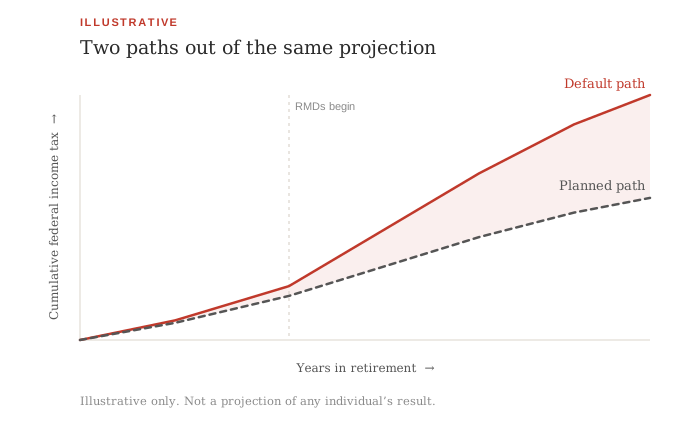
The lifetime tax projection is a baseline. It shows what the household pays if nothing changes: the default path. The value of seeing the number is not the number itself but the comparison: what the bill becomes when specific decisions are made differently, year by year, over a long enough horizon to matter.
The decisions that move the number are usually unglamorous. None of them require timing the market, taking on more investment risk, or finding a hidden strategy. They tend to be the same five or six levers in many households, applied at different times in different amounts.
For example, switching ongoing 401(k) contributions from pre-tax to Roth, when the math supports it, stops the tax deferred bucket from getting larger.
Filling lower brackets with Roth conversions in the gap years between retirement and RMDs, typically a five-to-fifteen-year window in which earned income has dropped, Social Security has not yet started, and the household has more control over its taxable income.
Funding an HSA and not touching it. The triple-tax-advantaged account many individuals use as a pass-through expense reimbursement, when the long-run math favors using it instead as a retirement planning account for health care expenses later in life.
Coordinating Social Security claiming with the conversion plan, so the year benefits begin is not the year a large conversion lands.
Sequencing withdrawals across taxable, tax-deferred, and tax-free accounts to help keep modified adjusted gross income beneath whichever IRMAA tier matters this year.
Coordinating with charitable intent, when present, through Qualified Charitable Distributions starting at age 70½ and Donor-Advised Funds in conversion years.
None of these are secret. All of them require looking at the projection across decades and deciding which lever to pull this year. That is the work. The number on the chart moves because the work gets done.
These are levers that apply broadly across high-earning households. They are not the only levers. Households with a closely held business, real estate holdings, multiple beneficiaries, or significant charitable intent may have additional planning paths available: buy-sell coordination, depreciation timing, beneficiary structuring, donor-advised funds, charitable remainder trusts. Each of those deserves its own treatment. The point here is the smaller one: even without those circumstances, six unglamorous levers could help move the lifetime number by a meaningful amount.
A pattern I see — a hypothetical example
A couple, both retired at sixty-two, with $2.3 million between two IRAs and a Roth balance under $50,000. Three years until Medicare. Eleven years until RMDs. Maybe fifteen years until the widow’s penalty becomes a real exposure for whichever spouse outlives the other.
The conventional plan was sound. Live off taxable savings, defer Social Security, take RMDs when forced, file the return. Their advisor was responsive. Their CPA was excellent. Nothing was broken.
The retirement lifetime projection might show that the same plan, run forward through the surviving spouse’s age ninety, would generate a federal tax bill in the seven figures, with the heaviest pressure landing in the years after the first death: single brackets on the same RMD income, IRMAA tiers locked in two years prior, the standard deduction halved.
The fix does not have to be dramatic. They might convert into the 22% bracket each year for nine years, watch the IRMAA threshold two years downstream, leave the investments alone. The number on the chart drops meaningfully, and the largest portion of the savings lands on the survivor’s side of the timeline.
The math wasn’t what surprised them. The fact that no one had shown them the chart was.
THE BOTTOM LINE
The Bill Is Real Whether You Look at It or Not.
For high-earning retirees, the lifetime tax bill is often the largest expense in retirement. It is paid in pieces, year by year, often without anyone naming the cumulative total. It does not require a tax law change to be expensive. It can be expensive on the current law, in the current brackets, under the current rules. The OBBBA did not change the size of the underlying tax obligation. It only made the bracket structure predictable.
Building the projection is the smaller share of the work. Implementing it takes years. Two paths emerge from the projection: the default path and the planned path. The difference between them is, for many households, a dramatic amount across the rest of their lives.
Whether the household ever sees that number is, ultimately, a decision the household makes.
If that is how you think about this, I am glad to help.
If it is not, that is fine too.
FREQUENTLY ASKED QUESTIONS
Common Questions About the Lifetime Tax Bill, IRMAA, and Retirement Tax Planning
How much will I pay in taxes in retirement?
In projected scenarios under current law, a $1 million pre-tax retirement balance can produce a cumulative federal income tax of $1 million or more across the retirement years, depending on growth assumptions, withdrawal timing, and surviving-spouse single-filer years. Larger pre-tax balances produce proportionally larger projections. Your projected number depends on account balances, retirement age, Social Security claiming age, growth rates, and bracket structure, but in my experience, the working-years assumption that “I’ll be in a lower bracket in retirement” rarely holds for households with $1.5 million or more in pre-tax accounts. Required minimum distributions starting at 73 or 75 force ordinary income whether the household needs it or not, and that forced income often pushes households into brackets similar to or higher than their working years.
What is a retiree’s lifetime tax bill?
The retiree’s lifetime tax bill is the cumulative federal income tax a household will pay from the time they retire through the death of the surviving spouse, projected under current law and current account structure. It is calculated by projecting taxable income year by year: wages in retirement, if any, Social Security, required minimum distributions, taxable account income. The bracket structure is then applied to each year. The number is not on any tax form because no document a household receives is responsible for assembling it. A Retirement Tax Diagnostic™ produces this baseline. Planning decisions like Roth conversions, withdrawal sequencing, charitable strategies, and Social Security timing are then tested against the baseline to see how much the lifetime number changes.
Are tax brackets going up in 2026?
No. The One Big Beautiful Bill Act, signed July 4, 2025, made the TCJA bracket structure permanent. The seven brackets remain at 10%, 12%, 22%, 24%, 32%, 35%, and 37%, with the top rate hitting taxable income above $640,600 for single filers and $768,700 for married couples filing jointly in 2026. The standard deduction stayed elevated at $16,100 single and $32,200 married filing jointly. The estate tax exemption was made permanent at $15 million per person. The “convert before the cliff” urgency that drove planning conversations from 2023 to 2025 no longer applies.
What is IRMAA and how does it work?
IRMAA, the Income-Related Monthly Adjustment Amount, is a surcharge added to Medicare Part B and Part D premiums when a household’s modified adjusted gross income exceeds certain thresholds. In 2026, the surcharge begins at $109,000 of MAGI for single filers and $218,000 for married couples filing jointly. The top tier costs an additional $487 per month for Part B and $91 per month for Part D, roughly $6,936 per person per year above the standard premium. IRMAA uses a two-year lookback, so 2024 income determines the 2026 premium. A Roth conversion this year may not affect Medicare premiums for two years, but the bill will arrive.
How can I lower my taxes in retirement?
The mechanisms are not exotic. Some of the most common levers are: switching some current 401(k) contributions from pre-tax to Roth; funding Roth IRAs and HSAs where eligible; running Roth conversions in lower-income years between retirement and the start of required minimum distributions; coordinating Social Security claiming with the conversion plan to avoid stacking large income years; sequencing withdrawals across taxable, tax-deferred, and tax-free accounts to help manage modified adjusted gross income against IRMAA tiers; and using Qualified Charitable Distributions starting at 70½ to help satisfy required distributions without recognizing income. The work is in the timing and the amounts, not necessarily in finding new strategies.
Should I do a Roth conversion before retirement?
It depends. The conversion math tends to favor years when the household’s marginal bracket is lower than it will be later. That is typically the gap between retirement and the start of required minimum distributions, when earned income has stopped, Social Security has not started, and the household has more control over taxable income. A multi-year conversion plan filling lower brackets, with attention to IRMAA thresholds two years downstream, can help produce a meaningfully smaller lifetime tax bill. The decision depends on current bracket, projected future bracket, available outside cash to pay the conversion tax, and the household’s broader plan. It is a how-much-each-year question, not a yes-or-no question and should be made in consultation with your tax and financial professionals.
Does present value matter when comparing today's tax to future tax?
Yes, and any rigorous projection accounts for it. A dollar of federal tax paid twenty years from now is not equivalent to a dollar paid this year. At a 5% discount rate, that future dollar carries a present value closer to $0.38. The case for paying tax earlier through a Roth conversion does not, however, reduce to "pay $100 now to save $200 later." When the conversion tax is funded from outside accounts, the converted dollar compounds tax-free for the remaining horizon, and outside cash equal to the tax owed helps effectively migrate into the tax-advantaged side of the household’s balance sheet. When the tax is paid from inside the account, the comparison reduces to a marginal-rate question: current rate versus projected future rate, with IRMAA, Net Investment Income Tax, and widow’s-bracket effects layered on. Both the nominal and present-value views of the lifetime tax bill belong in any serious projection. The decisions that lower one tend to lower the other.
What’s the difference between a CPA and a tax-aware financial planner?
The two roles do different work, and a household with serious retirement assets generally benefits from both. A CPA prepares the return: calculating what the household owes for the prior year, capturing deductions, ensuring accuracy and compliance. The work is generally retrospective by design and indispensable when done well. A tax-aware financial planner builds the projection: modeling what the household is expected to owe across the next thirty years, identifying years where bracket-filling, conversion, or sequencing decisions can lower the cumulative bill, and coordinating those decisions with the investment and income plan. The two functions complement each other. A household that has only one of them is often missing the other.
How is a lifetime tax projection different from what my tax software shows?
Tax preparation software computes this year. It cannot model required minimum distributions starting in 2032, IRMAA tiers in 2034, or the survivor’s tax exposure in 2042, because that is not what tax preparation software is built for. A lifetime projection assembles those years into one document, applying current law to each year’s projected taxable income, and summing the result. The output is a single cumulative number. More importantly, it is a year-by-year line against which alternative decisions can be tested.
What is a Retirement Tax Diagnostic™?
A Retirement Tax Diagnostic is a one-time projection that produces a retiree’s lifetime federal income tax baseline under current law, including the potential IRMAA surcharges layered on top. It is the answer to the question: “If we change nothing, what does this household owe in federal income tax across the rest of our lives?” The Diagnostic does not, by itself, fix anything. It establishes the number that planning decisions are measured against. A household that has seen the projection at least once is often in a different position than one that has not, regardless of what they decide to do next.
See your own Lifetime Tax Bill.
The Retirement Tax Diagnostic is a no-cost review of your projected federal tax across retirement. Your number, calculated from your situation.
Todd Talbot, CFP®, Financial Advisor, Certified Tax Specialist™, is the founder of Red Mountain Financial in Birmingham, Alabama. He specializes in tax-aware retirement income planning for high-income pre-retirees. He is the author of Should You Maximize Social Security? Maybe. Red Mountain Financial operates as a fee-based advisory practice with CreativeOne Wealth (RIA). Custodian: Charles Schwab.
Disclosure: These are general observations about retirement tax planning principles. They reflect patterns and tradeoffs that apply broadly, not to every situation. Lifetime tax projections rely on assumptions about future income, growth rates, account balances, and tax law that may not match actual results. Bracket structure and IRMAA thresholds reflect 2026 law as of the time of writing and are subject to change. Nothing here constitutes personalized investment, tax, or legal advice. Consult a qualified tax and financial professional before implementing any strategy.
Converting an employer plan account to a Roth IRA is a taxable event. Increased taxable income from the Roth IRA conversion may have several consequences including (but not limited to) a need for additional tax withholding or estimated tax payments, the loss of certain tax deductions and credits, and higher taxes on Social Security benefits and higher Medicare premiums. Be sure to consult with a qualified tax advisor before making any decisions regarding your IRA. Roth distributions are tax free after age 59-1/2 and the account has been open for at least 5 years. COD00029113
Investment advisory services offered through CreativeOne Wealth, LLC, a Registered Investment Advisor. CreativeOne Wealth, LLC and Red Mountain Financial are unaffiliated entities.
Investment advisory services are provided in accordance with a fiduciary duty of care and loyalty that includes putting your interests first and disclosing conflicts. Insurance services have a best interest standard which requires recommendations to be in your best interest. Advisors may receive commission for the sale of insurance and annuity products. Additional details including potential conflicts of interest are available in our firm’s ADV Part 2A and Form CRS (for advisory services) and the Insurance Agent Disclosure for Annuities form (for annuity recommendations).
We do not provide tax or legal advice. Always consult with qualified tax/legal advisors regarding your own unique circumstances.
Certified Financial Planner Board of Standards Center for Financial Planning, Inc. owns and licenses the certification marks CFP®, CERTIFIED FINANCIAL PLANNER®, and CFP® (with plaque design) in the United States to Certified Financial Planner Board of Standards, Inc., which authorizes individuals who successfully complete the organization’s initial and ongoing certification requirements to use the certification marks.
Licensed Insurance Professional. Provided content is for overview and informational purposes only and is not intended and should not be relied upon as individualized tax, legal, fiduciary, or investment advice. By contacting us, downloading booklets, or attending events, you may be offered a meeting to discuss how our insurance and other services can meet your retirement needs. The presenters of this information are not associated with, or endorsed by, the Social Security Administration or any other government agency.
Investing involves risk, including the loss of principal. No Investment strategy can guarantee a profit or protect against loss in a period of declining values. Any references to protection benefits or lifetime income generally refer to fixed insurance products, never securities or investment products. Insurance and annuity products are backed by the financial strength and claims-paying ability of the issuing insurance company.
Talbot & Talbot, Inc. D/B/A Red Mountain Financial | 4000 Eagle Point Corporate Dr., Birmingham, AL 35242 | P.O. Box 383033, Birmingham, AL 35238